Showing posts with label Research. Show all posts

Saturday, 11 October 2014

BARB: Evaluation Links

Previously Unposted

Using the internet has become a very easy way for me to collect all of the information that I need. To help me write up my coursework evaluation I used a range of different websites. Some of them I have already added to previous posts. However here are a few that I have only just recently used.


The link below is a massive internet database that collects weekly and monthly viewings of all television shows. The website is called BARB and it stands for Broadcasters, Audience and Research Board. I did check with my teacher that it would be a trusted source to use within my evaluation. I was informed that this particular website is an excellent source to use because it is trusted by all examiners and gives up-to-date information. 


Hope these websites help you find the information you need :)


Monday, 15 September 2014

Script Links

Previously Unposted
For help writing my script I searched all over the Internet to find bits of information that would help me to make my script the best possible grade on my script.

I found some website links that gave me different information about scripts.
http://www.sellascript.com/Source/column.cfm?mode=display&columnid=5
http://thescriptlab.com/images/SampleScript/FeatureScreenplayFormat.pdf
http://www.simplyscripts.com/WR_format.html

All of the links above do work if you click on them :)


The first one gives hints and tips on how to start a script.
The second link is a sample script template to show the best layout of a script and how long it should be,
The last link gives the dimensions of the margins and the other important punctuation etc. that needs to be added, to give your script the professional look.

This link below is the original script for the film 'The Blind Side'. This one is the most important to me whilst creating my coursework because I chose this film as one of my comparison examples.

http://www.imsdb.com/scripts/Blind-Side,-The.html


The IMSDB is a very well known website within the film industry as it holds a range of samples from film franchises such as Harry Potter etc. It also has sample scripts from Television shows such as Futurama .

Monday, 8 September 2014

Media Tips and Links

Previously Unposted 
When looking at films and their genre, it an sometimes be difficult to decided exactly which genre category some films fit into. 

As part of the Media Studies Course my teacher signed up to a site called media edusite which I believe ,was paid for as part of a package. My class and I were given individual log in details and passwords to access all of the content. 

I found this site very useful in understanding genre and helping me to construct my DVD cover and Poster by looking at genre conventions and the examples that are given. 

I would recommend this site as it give simple information with diagrams/images and written examples to back up the information. It also includes a range of different information that you may need and uses (and explains) proper media terminology. 

I hope you ,my readers, find this link as helpful as I did :) 

Below is a link to the one page that I used when deciding on a film idea and genre to place it in. The link does work if you click on it and takes you straight to the fantasy genre page. 

http://media.edusites.co.uk/article/fantasy-genre-codes-conventions/ 

Please Note: The whole page may not show up because the link is not logged on. To view the whole page and the whole website, you would have to sign up  :) 

Another link that I found that helped me make my script the best it can be is stated below 

http://screenwriting.4filmmaking.com/script-format1.html 

To help me save time when creating my DVD cover I also decided to start to plan the written content , as I am writing the script, so I thought I would ' kill two birds with one stone' as they say.  I used this website to give me an idea of how to right the blurb for my DVD cover.

http://www.ehow.com/how_8506705_write-dvd-cover-content.html 

Monday, 1 September 2014

Exam Prep.... Another Theory

Previously Unposted

http://www.mediaknowall.com/as_alevel/alevkeyconcepts/alevelkeycon.php?pageID=audience


The link at the top of this post is a very well know website, that was given to me and my media class by my media teachers.

The link takes you straight to a media page that explains about the different types of audience theory , with diagrams to show how the theory works. It also explains where the theory came from and who came up with the theory.

There are other websites that give you the same information , however I found this website to be the best for me to learn from as it does have diagrams and all the information is condensed down onto just one page. From the website I have used this website to create my own revision spider diagrams.


I hope that you find this website as helpful as I did.
(unfortunately the link does not work, however if you type it into your search engine it will go to the correct page.)

Sunday, 31 August 2014

Typography...Script...Typography...Script

Previously Unposted

As my media lessons have been split into focusing on coursework and my exam , these blog posts are starting to jump from one topic to another. I do apologise for this,as I am trying to update you (my audience) on what I am doing within each lesson.

This post is going to be short and sweet , as I am focusing all my attention this week on my coursework.

After deciding on a storyline for my coursework, I decided to push myself and aim to find a suitable font for my poster and DVD cover, whilst still writing up my script.


The deadline for the script (the pre-production) is closer than the deadline for the DVD Cover (post-production). However I thought that I would make things a little easier on myself by planning ahead and making sure I had all of the research I needed to create all of my coursework quickly and efficiently so that I would have time to make corrections if needed.

Taking a break from script writing, I decided to create a word document of all the fonts (Typography) that I could potentially use on my production pieces.After asking around my peers and both my media teachers I narrowed the options down to three . All 3 of these fonts I found on the website
www.dafont.com .

The reason I chose to use this site, is for the simple reason that the fonts are easy to download, there are a range of different designs to choose from , and you can even try out the font in the title that you want.

Below are the 3 fonts that I have to choose from for my production pieces. The links show my film title in the 3 fonts that I chose.

http://www.dafont.com/kiss-me-quick.font?text=Losing+Reality
http://www.dafont.com/from-me-2-you.font?text=Losing+Reality
http://www.dafont.com/alertse.font?text=Losing+Reality

Friday, 29 August 2014

Extra Coursework Research

Previously Unposted 


Research 

True Story Films 

  • Flowers In The Attic 
  • 8 Mile 
  • Born on the 4th July 
  • The Social Network
  • JFK
  • Saving Private Ryan 
  • To Catch A Killer
  • The Blind Side 
  • The Lovely Bones 
  • Titanic 
  • Pearl Harbor 
  • Brace Heart 

True Story Books 

  • Flowers In The Attic Series 
  • The Boy No-one Loved
  • Against All Odds 
  • Exploited 
  • Shattered Dreams 

Codes and Conventions of True Movies/ Films.
  • ·         Drama/tragedy
  • ·         Sometimes a happy ending
  • ·         Based on real time events
  • ·         Mostly starts from the past and pans out over the time of the event
  • ·         Crying/Kissing/Hugging
  • ·         Emotional/plays on the audiences emotions
  • ·         Tend to have a long screen time.
  • ·         Focus on the ‘victim’
  • ·         Opens the audiences eyes to the bigger picture of what actually goes on in the world
  • ·         Shows the audience a different perspective 

Thursday, 28 August 2014

Courswork: DVD Analysis

Previously Posted on 11/3/13

As extra research I also analysed the film's DVD covers as well for comparison.  These are shown below(From top to bottom)
1) The Blind Side
2) The Lovely Bones 
3) Titanic

DVD Cover Analysis of The Blind Side


DVD Cover Analysis of The Lovely Bones


DVD Cover Analysis of Titanic

Tuesday, 26 August 2014

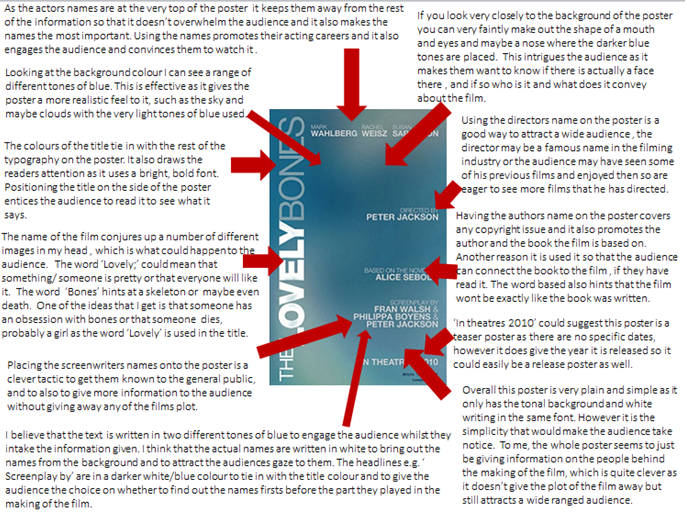
Coursework: Poster Analysis

Previously Posted on 11/3/13

Below are the three posters that I analysed for my coursework research. The 3 posters are (From top to bottom) 
1) The Lovely Bones
2) The Blind Side 
3) The Titanic
The Lovely Bones Poster Analysis


The Blind Side Poster Analysis


Titanic Poster Analysis


Sunday, 24 August 2014

Extra Links

Previously Unposted

After yesterday's post, I remembered that I had a a few more links that helped me with my pre-production work. 

Pre-Productions- This is the work that has to be completed before any filming can be started. This stage includes, writing scripts and storyboards for the setting of the film and the actors.  The film idea also develops more within this stage.


http://downloads.bbc.co.uk/writersroom/scripts/ripper-street-episode-1.pdf       - This link here is from the BBC website. It is the first part of the 'Ripper Street' script. I used this link because it helped me with the layout of my script and it also showed me how to introduce new characters/ settings etc. I definitely found this link to be helpful .. and I hope you (my audience) do to :)  


Coursework: Links

Previously Unposted

To help me create the best possible coursework piece, I decided to do some of my own research by looking at different links on the internet to help me write my own treatment to pitch my film to the rest of my media class.

Below are some website links to the information that I researched.

The first link does not work properly, so you have to type it manually into your search engine. This one is a
a guide on how to write a script.

The second link does work and is a guide on how to write a treatment.

The last link is a step-by-step guide on how to create a storyboard.  (  http://en.wikipedia.org/wiki/Storyboard) This link explains in better detail than I every could what a Storyboard is  :)


LINKS 
http://www.writersstore.com/how-to-write-a-screenplay-a-guide-to-scriptwriting
http://www.movieoutline.com/articles/how-to-write-a-treatment.html
http://writersgateway.wordpress.com/2007/05/21/8-easy-steps-to-create-a-storyboard/

Monday, 18 August 2014

Research Methods

Previously Unposted 

When starting to research my potential film idea my teacher gave me a list of research methods that could help me to find relevant information to help me with my coursework.

I decided to type up the list, in case I did lose the original. From this I looked at the research methods and added information about them to help me when I wrote my Bibliography in my report :) 

Here is the list that I typed up :) 


Research Methods
NRS
NRS creates new ways for the media to make money. They also create international commercials to help advertise media companies.

NRS Media, which used to be called New Revenue Solutions, was founded in New Zealand in 1991 as a consultancy firm. This company works in mainstream media and they have offices within Canada, Europe and the United Kingdom.

NRS Media has ensured that their media partners have achieved this sales goal. Our experience and proven performance will help you generate substantial revenues and profits, ensuring your first year’s success.

ABC
The ABC Media company is a company that specialises in selling a range of various different media channels that all work together to produce the same outcome. This company also provides brands and advertisers with access to millions of customers using digital networks, sales channels and many more.


BARB
BARB stands for the Broadcasters' Audience Research Board. This company is the primary provider that measures the UK’S television audience. BARB covers all television channels that broadcast across all areas. For example: Satellite, Cable (both digital and analogue) and terrestrial.

This is a limited company that does not make any profit, and is funded by some of the major television programs and advertising companies. For example: BBC, Channel 4 and 5, ITV and TPA which stands for the Institution of Practitioners in Advertising.


Other types of broadcasters also contribute to the running cost of BARB by subscribing to the service that BARB provides. Some of these companies are: Advertisers, Publishers and Research specialists.

Friday, 15 August 2014

Coursework: The Briefing

Previously posted on 19/2/13 


The Brief  For my coursework I had to come up with a film idea. I had to create a pre-production and production piece. The pre-production was the option of either writing a script or creating a story board. The production piece was the same for everyone; create a DVD cover and at least 1 poster that conforms to the codes and conventions of your film idea.

I decided to create a script for my pre-production and a teaser poster and a DVD cover for my production tasks. I chose this option because I found through my practice task (see hobbit post) I was quicker at creating the script, and I enjoyed playing around with the dialogue, which means I can be more imaginative.

My film genre is going to be true story, because I wanted to show how not everyone has the perfect childhood and how they deal with these imperfections.  To ensure anonymity , I altered the characters names and the situations so more people could relate to the idea. I also thought about writing a disclaimer so that the audience knew that all characters names were fiction. I did some secondary research on the genre by looking at different true films such as 'The Blind Side, 'Titanic', and 'The Lovely Bones'.  I analysed film posters to get a better understanding of what my poster should convey, such as images/ typography to give the audience the correct image. Creating a mood board of true movie film posters/ DVD covers helped me to compare and contrast the types of colours/ layouts/ fonts used. 

For script assistance I studied different types of scripts (websites mentioned below) and used Google’s search engine to look at different types of script layouts. Relating back to my practice task also gave me inspiration.


These are the questionnaires that my focus group  filled in.
I undertook primary research through a focus group by asking them questions about my idea. I took note of their answers and adapted my work towards their responses. From this I decided to target my film towards the female population aged 12A and above.  

When I knew who my target audience was, I started looking at audience theories. The one that applies to my work is the uses and gratification theory because it reflects my text and the theory shows how an audience can relate to what they see, which is the way want my target audience to react to my film.

My focus group also came up with more true movies: 


  • Anne Frank 
  • Boy in the striped pyjamas' 
  • Call the midwife ( TV Drama Series) 
  • Life of Pi 
  • Music of the heart


For more research I looked at the marketing campaigns and DVD releases for these titles for inspiration. As the Life of Pi has recently been released, I compared all the film posters and made notes on what made the poster eye-catching and the composition of the whole text.

Using the BARB website I found that call the midwife had a rating of 10.18 million viewers on 30th December 2012 and 10.85 million viewers on the 3rd February 2013. This hints that there is a huge audience out there that enjoy watching films/TV series based on real life. This research helps with my marketing campaign as it shows that I would have to persuade a wide audience range to see my film. 


Next I found different true story books for film title ideas. To help me decide, I wrote out a list of different titles that I came up with and narrowed it down to a top 3:
  • Losing reality
  • The reality of being me 
  • Life is calling 
I added these titles to my questionnaire and the focus group helped me to decide on LOSING REALITY as the title. Once I decided on the title it was time to write my script! 

Here are some of the websites that I used to gather the research :

Wednesday, 13 August 2014

COURSEWORK:The Start

Previously Unposted 

Soon after submitting my work about 'The Hobbit', just after the Christmas Holidays, my teacher gave us a  2 hour introduction into our Coursework for the year.  Within these 2 hours we were shown
* PowerPoint's with information on 
*Booklets to guide us
* Templates
* Research links for websites
* Recommended books/newspapers
 *Examples from previous students work
*Examiners reports 

As a class we were also told that as homework we should go and research some ideas we may have about our coursework. 

We were also given a basic outline of everything that was expected of us to complete and a rough idea of how long we would have to work on the coursework.

Due to the amount of information that we were given, my class were told that our next media lesson would be our first official coursework lesson, where we would get the brief for our coursework and would be given the lesson to work on our ideas we may have and to have a one-on-one conversation with the teacher so that we could agree on a coursework idea and sign it on the brief as an official coursework idea. 

I will keep this blog updated on the progress I make whilst doing my coursework. 

Please Note: I will be updating this blog with posts concerning my coursework and my exam preparation :) 

Tuesday, 12 August 2014

The Hobbit: Extra Work

Previously Unposted
Hi everyone,

Following on from my post about my Christmas homework about 'The Hobbit', I decided to upload a photo of the mood board that I created to help me with the research :)

My definition of a  Mood Board is: a page/sheet (generally A4/A3 sheet of paper) filled with images (can contain some words ) that are all related to the same topic. Mood Boards can be created for anything and everything e.g. films, books, colours, make-up , superhero's etc. :)

The mood board I created consisted of images from 'The Hobbit' and 'The Lord Of The Rings'.


Due to the film being highly publicized and a highly anticipated film release, it was difficult to find images that were not posters or book covers or even images that were not related to 'The Lord Of The Rings' franchise :) .


Monday, 11 August 2014

The Hobbit: Evaluation

Hey guys,

I know I have not updated my blog in a while, but I have a good excuse :) 
Over the Christmas holidays I have been working on a project that is going to prepare me for my coursework in 2013.

The project that I have been working is a marketing campaign for 'The Hobbit'. For the marketing campaign I had the task of :
*Doing background research about the book/film
*Create a storyboard for the first half of Chapter One of the book
* Write the pitch and treatment for the film
*Create a DVD cover
*Make a teaser poster for the film

For the research I read some of the book to get a better idea of the characters and settings and I looked on Google images for DVD covers of action-adventure films. I also created a mood board of all different interpretations of 'The Hobbit' and I created a list of the different films that were the same genre of the film, such as Tron, Harry Potter and a few more. Another thing that I did was look at different Harry Potter film posters for ideas.

I adapted the codes and conventions from the research through a number of different ways. For my pre-production tasks; the storyboard and the script, I used the mood boards to get an idea of what the characters could look like and I also read the book to see how the characters are conveyed and how the Author of the book, wanted the characters to speak.

For the research into the target audience, I looked at the age ratings for the rest of the Lord of the Rings trilogy, and I also looked at the age ratings for other action-adventure. Another bit of research that I did was some secondary research on who would go and see an action-adventure film.I did this by looking at the codes and conventions of the film and seeing what audience it could appeal to.

I took all of the research for my target audience and used it in the process of creating my production artifacts. I did this by looking at all the research and deciding what age rating I should give the film and then designed the poster and the DVD cover based on what I thought would be suitable for the age rating. I also used Google to look at what the types of codes and conventions a film of that age rating portrayed.

After finishing my DVD cover and teaser poster I looked over them and I am happy with the way they turned out. Some of the features I am happy with are :
* I am happy with the colours that I used as I find they work well for what I am trying to convey.
*The design I have used works well with the colours.
*The layout of the design as it fits well on the cover . (The DVD)
* The design fits well with the story of the book.
*I believe that how I've drawn them conveys how I see it in my minds eye.

Looking over the production artifacts I have noticed that there are certain things that I could have done better.
* I could have spent more time on both of the designs
*There could have been more annotations on the products
* The poster could include more of the magical aspect of the book/film
* Maybe the colours on the poster could have been more realistic

The overall effectiveness of my final products is not as effective as it could be, however I do think that they work well with the film and the book. They also convey what I am trying to get across towards the audience, and for my first crack at doing this sort of thing, I think it turned out pretty well.

Thursday, 7 August 2014

Analysis help

Previosuly Unposted 

Hi bloggers,

After submitting all of my text analysis such as the poster analysis and the written analysis (see previous posts), I decided to research the best way to analysis media texts and how to get the top marks within an exam.

Below are the two websites that I found  the most useful:
 1)  http://www.ehow.com/how_4925370_analyze-film-trailer.html  - This link does work and it gives you a step by step guide on how to analyse any media text print or moving image. Within each step it tells you what to comment on and how to go about it. :)

2)      http://cw.routledge.com/textbooks/9780415448239/control.asp - Unfortunately this link does not work :( .. but you can type the link into your search engine and it should work :). This website outlines the exam and also gives you an example trailer to watch and analysis. It then gives you all the information that you could have written about and does it in sections so it doesn't confuse the reader. :)

Even though these websites did work, I do think that the best way to get good at textual analysis is to practice and get someone else to check over the work and give constructive criticism. By doing textual analysis , it also helps with your English language skills, through spelling, constructing sentences, punctuation and essay writing.

I hope the links help :)